

B2: Hyperlexia
Below is a B2 level English task designed by Academic Tutors USA. Good luck and enjoy!
Heading 1
--- --- ---
Hyperlexia is a reading condition where the student is able to decode the words but is not able to comprehend. Silberberg and Silberberg (1967) coined the term hyperlexia to refer to this phenomenon. This condition is often seen in students with ASD who learn the art of decoding but don’t have the language skills to comprehend. Advanced word recognition skills in the absence of comprehension have often been reported for a long time and references in the research go back to 1945.
In the The Simple View of reading (Gough & Tunmer, 1986) they state that:
Decoding x Linguistic Comprehension = Reading Comprehension (Note that both a required a Reading Comprehension is the product of Decoding and Linguistic Comprehension not the sum).
For children with Hyperlexia the linguistic comprehension component is lacking.
Scarborough reading rope (2001) takes this theory a step further. The different components of language comprehension are broken down into: background knowledge, vocabulary, language structures, verbal reasoning and literacy knowledge. All of these can be impaired in hyperlexic students and some diagnostic investigation will be required to determine which is they key factor and different stages in their development.

The word hyperlexia is made from ‘hyper’ meaning better than and ‘lexia’ meaning reading. This is a rare condition and I have only seen a few diagnosed cases in my 20 years of teaching. Due to the rarity of the condition, there are no facts and statistics about its frequency. We do know that there is a link and hyperlexia is often diagnosed comorbidly for students with ASD. About 6-14% of students with ASD have hyperlexia and and approximately 84% of children with hyperlexia have autism. However, a student can hyperlexia alone or with other comorbid disorder such and language difficulties.
How to teach a student with hyperlexia?
When teaching a child with hyperlexia it is important not to assume that they have understood the text they have read. They will probably have read the book quite quickly and be ready for the next one having decoded all the words but not taken much meaning. In order to establish the areas of comprehension difficulty for the student it is useful to complete a diagnostic tool to help see their strengths and weaknesses. There are not a great number of these I have found but using a few of the Cars and Stars assessment tasks can begin to create a picture of where the strengths and weaknesses lie and areas of focus. From this I can develop a personalised approach to remediate the specific difficulties.
Phonological Awareness – It is well known that phonological awareness is a key deficit in Dyslexic students. The research is also suggesting that phonological awareness can be weak in students with hyperlexia as they have rote learnt to read without the underlying structures. The PAST assessment will give to you a good understanding of their strengths and weaknesses and there is also an intervention to use to remediate the specific difficulties.
Visualising – This is a key skill to teach students with comprehension difficulties. From my personal experiences working with students who have comprehension difficulties they do not naturally make a movie in their head of the story as they read. The Visualise Verbalise Program by Nanci Bell is a great program to teach this skill. There is the main theory and program book but also a number of different work books at different levels to teach the skill in context of text.
Explicit Teaching – Explicit teaching of comprehension skills relating to inferencing, using facts, and analogies supports the development of comprehension skills.
Story grammar and mapping – Once a student has read the text developing a story map can really help to deepen their understanding of the text, the sequence, the relationships between the characters and so much more. There are many graphic organisers that can support this task. I recommend keeping them simple.
Teach sequencing – Sequencing can be taught using pictures and key phrases from the text in the early stages. For picture books you can sequence the pictures from the book, especially with the text removed so they have to use their language skills.
Teach cause and effect – Cause and effect needs to be taught as a concept before being taught in relation to text to ensure the child knows that one action leads to an outcome e.g. if I boil the kettle the water gets hot. Laura Numeroff’s books “If You Give…” series of books (including If You Give a Mouse a Cookie, If You Take a Mouse to School, etc.) are great starting points for discussion.
Generating and Asking Questions – The art of asking questions about a text involves looking more deeply and manipulating the information which we know is part of how the brain is wired. Initially, the questions will be simple but with support and guidance the student will be able to develop this skill. This could be done paired with an adult or a peer. Working with a peer also helps to develop social language which may also be deficit. In reciprocal questioning as a comprehension strategy children are taught to generate and respond to questions, using a story map framework.
Sentence level comprehension – This may be the starting point for comprehension and certainly understanding just a few linked sentences will be a key part of intervention. The Reading Comprehension Blueprint has an excellent chapter on the importance of sentence level comprehension skills.
Vocabulary – As an adult is can be easy to assume that students know the meaning of everyday words. Words can be divided into 3 types:
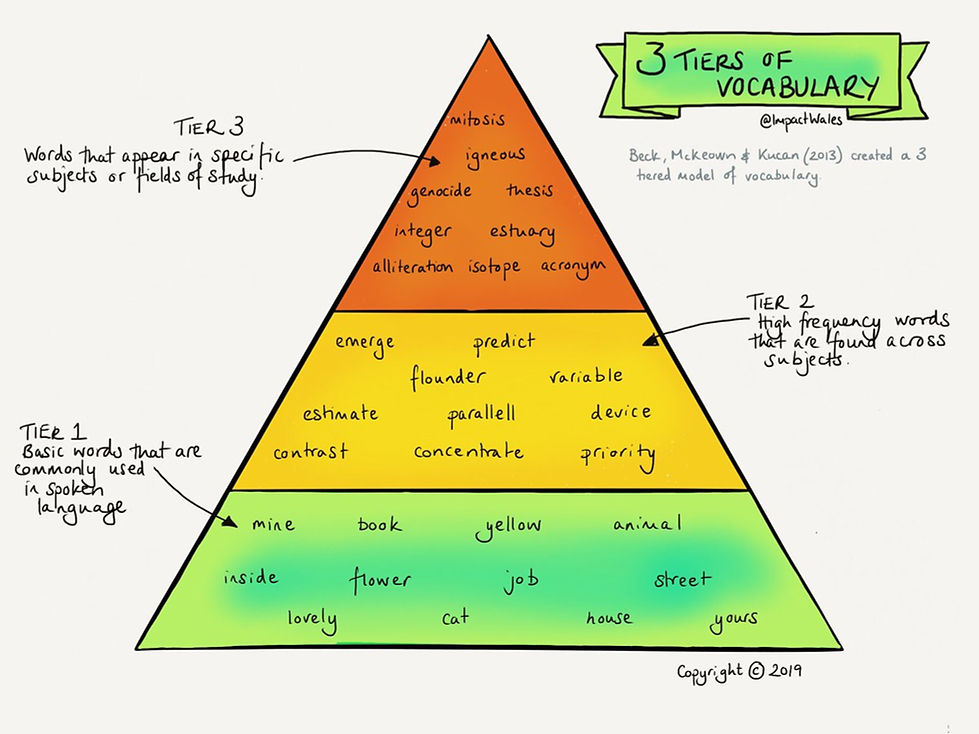
Acknowledgements to Impact Wales for the image.
For students with hyperlexia do not assume tier 1 words have been learnt and understood through every day conversation. Tier 2 and 3 words will likely need to be explicitly taught. This video by Anita Archer is a good example for Primary aged students.
Theory of mind – For students who have ASD they lack theory of mind which impairs their ability to understand the motives and actions of characters, especially in stories. Role play of stories can help to bring stories to life and help support understanding.
Semantics – this refers to understanding the meaning of words and phrases. Students need to understand how words and phrases link together.
Anaphoric Cuing – This is a proven strategy for teaching comprehension for students with ASD. Anaphoric cueing is a teaching method which teaches the student to support the student to match up the pronouns in the text. For example, if a student comes across the word ‘he’ they then check through the property and find otehr words which relate to the same ‘he’. For example, Rob went to the shops and he bought 5 apples. In this sentence Rob and he both refer to the same person. Other words to explore with anaphoric cuing are she, they, them, him, her, etc.
Teaching Oral Language Skills – some students will benefit from the support of a Speech Pathologist to develop their oral language skills which impact their reading comprehension. It is well known that oral language precedes written language and that reading develops and extends their language.
Summary
For students with comprehension difficulties, they need to receive explicit instruction in comprehension using authentic texts. The teaching focus needs to be matched to the specific students needs.
Hyperlexia Quiz: Understanding and Support Strategies
Directions for Students:
Read each question carefully. Choose the best answer (A, B, C, or D) by circling or highlighting it. This quiz has 10 questions based on Tracy Ashbridge's article on hyperlexia. Answers are randomized in position to encourage careful reading. No back-to-back repeats of correct positions. Complete independently in 15-20 minutes. Good luck!
Question 1: What is hyperlexia primarily defined as?
A. A strong desire to learn through visual aids only
B. Advanced reading ability before age 5, with comprehension challenges
C. Slow reading development linked to hearing loss
D. Exceptional math skills paired with speech delays
Question 2: Hyperlexia is often associated with which condition?
A. Giftedness in all academic areas
B. Autism Spectrum Disorder (ASD)
C. Attention Deficit Hyperactivity Disorder (ADHD)
D. Dyscalculia
Question 3: Which is NOT a common characteristic of hyperlexic students?
A. Precocious reading of words without full understanding
B. Fascination with logos, letters, or numbers
C. Strong verbal comprehension from early ages
D. Literal interpretation of language
Question 4: What brain difference is linked to hyperlexia in research?
A. Overactive visual processing areas
B. Enlarged language centers in the left hemisphere
C. Reduced activity in the right brain
D. Hyperactive frontal lobes for planning
Question 5: According to the article, what is a key challenge for hyperlexic learners?
A. Difficulty decoding words
B. Comprehension lagging behind word recognition
C. Avoidance of all printed materials
D. Perfect recall of memorized texts
Question 6: Which strategy supports comprehension in hyperlexic students?
A. Ignoring visuals entirely
B. Pairing text with images and real objects
C. Focusing solely on phonics drills
D. Speed reading exercises
Question 7: What type of language do hyperlexic children often use?
A. Complex metaphors early on
B. Echolalia or scripted speech
C. Advanced poetry composition
D. Fluent storytelling
Question 8: How can teachers build on hyperlexia's strengths?
A. By discouraging early reading
B. Using their visual memory for concept mapping
C. Limiting exposure to books
D. Emphasizing oral drills over print
Question 9: What is recommended for social skill development?
A. Isolate for independent reading
B. Role-play scenarios with visual supports
C. Avoid group activities
D. Focus only on academics
Question 10: Which assessment tool might help identify hyperlexia?
A. Standard IQ tests alone
B. Observation of reading vs. listening comprehension gap
C. Math achievement benchmarks
D. Physical coordination exams
Answer Key (for Teachers Only - Detach or Hide):
1-B, 2-B, 3-C, 4-A, 5-B, 6-B, 7-B, 8-B, 9-B, 10-B
Section Title
Small Title
This is a Paragraph. Click on "Edit Text" or double click on the text box to start editing the content and make sure to add any relevant details or information that you want to share with your visitors.
Small Title
This is a Paragraph. Click on "Edit Text" or double click on the text box to start editing the content and make sure to add any relevant details or information that you want to share with your visitors.
Small Title
This is a Paragraph. Click on "Edit Text" or double click on the text box to start editing the content and make sure to add any relevant details or information that you want to share with your visitors.
Small Title
This is a Paragraph. Click on "Edit Text" or double click on the text box to start editing the content and make sure to add any relevant details or information that you want to share with your visitors.
Section Title
This is a Paragraph. Click on "Edit Text" or double click on the text box to start editing the content and make sure to add any relevant details or information that you want to share with your visitors.