

B2: Tunnel Rats in the Vietnam War
Below is a B2 level reading task about the tunnel rats in the Vietnam War. Good luck and enjoy!


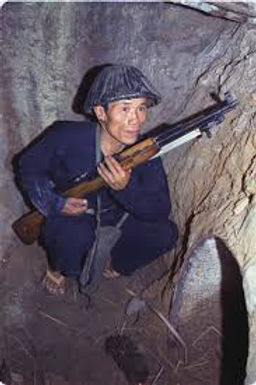
A Brief Introduction to the Tunnel Rat
-
Tunnel Rats were specialized soldiers during the Vietnam War who undertook the dangerous mission of entering, exploring, and destroying enemy underground tunnel systems, primarily constructed by the Viet Cong. These tunnels were extensive, often running for hundreds of kilometers, and contained living areas, weapon caches, hospitals, and command centers.
-
Mission & Role
Tunnel Rats were tasked with locating tunnel entrances, infiltrating the confined spaces, and clearing them of enemy combatants, booby traps, and supplies. They worked in complete darkness or with minimal light, often armed with only a pistol, flashlight, and sometimes a knife due to the narrow corridors and risks of ricochets or explosive hazards
-
Dangers Faced
Operating in extremely tight and dangerous conditions, Tunnel Rats faced a high risk of booby traps, collapses, poisonous gases, sudden inundation by water, venomous animals, and ambushes from enemy soldiers in close quarters. The casualty rate for these soldiers was notably high, around 33 percent. Many tunnels were designed to be defensively complex, featuring sharp U-bends, traps, and poison gas to deter or kill intruders
-
Notable Operations and Impact
Tunnel Rats played a crucial role in compromising the Viet Cong's ability to wage guerrilla warfare. They uncovered intelligence, captured or killed fighters, and destroyed vital resources. In various operations, they managed to neutralize enemy forces, seize large amounts of weapons, and gather tactical information that was instrumental for further military actions. Their actions forced the Viet Cong to alter tunnel construction and increased the overall risk for North Vietnamese guerrillas using the tunnels
-
Legacy
While their contributions were critical, the psychological and physical toll on Tunnel Rats was immense, and many suffered lasting effects from their service. Their unique bravery, adaptability, and teamwork are remembered as an extraordinary but lesser-known aspect of the Vietnam War, marking them as some of the conflict's most courageous and resourceful combatants
-
Notable Vocabulary
- Paragraph 1
Tunnel Rat ---> a soldier, often a volunteer, tasked with entering Viet Cong tunnel networks to clear them of enemy combatants, booby traps, and intelligence
Viet Cong ---> a Communist-led guerrilla force in South Vietnam that fought against the South Vietnamese government and the United States during the Vietnam War
Extensive ---> covering a large area; having a great range:v
Weapon Caches ---> a hidden store of weapons and ammunition, often kept in a secret location for later use
- Paragraph 2
Booby traps ---> something dangerous, especially a bomb, that is hidden inside somewhere that looks safe:
Pistol ---> a small gun that is held in and fired from one hand:
Flashlight ---> a small light that is held in the hand and usually gets its power from batteries :
Knife ---> a tool, usually with a metal blade and a handle, used for cutting and spreading food or other substances, or as a weapon:
- Paragraph 3
Collapses ---> to fall down suddenly because of pressure or having no strength or support:
Poisonous Gases ---> a toxic gaseous substance used to harm or kill through inhalation or skin contact.
Inundation ---> a flood, or the fact of being flooded with water:
Venomous ---> a poisonous liquid that some snakes, insects, etc. produce and can put into another animal's body by biting or stinging
Ambushes ---> to suddenly attack someone after hiding and waiting for them:
- Paragraph 4
Compromising ---> causing damage to the reputation of someone, especially making known that they have had a sexual relationship with someone who is considered unsuitable:
Guerilla Warfare ---> engagement in or the activities involved in a war fought by small groups of irregular soldiers against typically larger regular forces.
Vital ---> necessary for the success or continued existence of something; extremely important:
Neutralize ---> to stop something or someone from having an effect:
Seize ---> to take something quickly and keep or hold it:
Instrumental ---> serving as a means of pursuing an aim or policy.
Alter ---> change or cause to change in character or composition, typically in a comparatively small but significant way.
- Paragraph 5
Critical ---> of the greatest importance to the way things might happen:
Toll ---> he number of deaths, casualties, or injuries arising from particular circumstances, such as a natural disaster, conflict, or accident.
Immense ---> extremely large in size or degree:
Lasting effects ---> a result or influence that continues to be significant over a long period of time
Courageous ---> not deterred by danger or pain; brave.
---


How “Tunnel Rats” Fought the Viet Cong in Underground Tunnels in Vietnam
American and Australian “tunnel rats” were tasked with the gruesome mission of destroying the enemy underground.
by William P. Head3/6/2023
The Viet Cong were well known for their devious jungle ambushes and cruelly ingenious booby traps. But one of the enemy’s deadliest—and stealthiest—techniques was to burrow in underground tunnels deep beneath the earth’s surface and launch attacks from the cover of dark and labyrinthine caverns.
The Americans and their allies who took on the gruesome task of rooting out and defeating these hidden foes earned the humble but proud nickname of “tunnel rats.” Yet, in their first large-scale encounter with underground enemies at Cu Chi, the “tunnel rats” and their fellow soldiers were far from prepared for the horrifying dangers that lurked below them.
Operation Crimp
Operation Crimp, undertaken by U.S. and Australian forces in Binh Duong Province, South Vietnam, from Jan. 8-14, 1966, was the largest search and destroy action during the Vietnam War for its time. Maj. Gen. Jonathan O. Seaman, commander, 1st Infantry Division, was the overall allied leader. Combat units included 8,000 soldiers from the 1st Infantry Division, composed mainly of troops from the 1st Infantry Division’s 173rd Airborne Brigade and the 3rd Brigade. The 1st Battalion, Royal Australian Regiment, operating as part of the 173rd, played a significant role in the operation.
The mission, according to the After-Action Report written by Col. William D. Brodbeck, commander of 3rd Brigade, and staff member 2nd Lt. Leo J. Mercier, was to “strike at the very heart of the Viet Cong [VC] machine in Southern RVN [Republic of Vietnam], the notorious ‘Hobo Woods’ Region in Binh Duong Province, just West of the fabled ‘Iron Triangle’ believed to be the…headquarters of the Viet Cong Military Region 4” (within the area U.S. forces designated the III Corps Tactical Zone).

Two U.S. Army soldiers search a tunnel in Qui Nhon for enemy fighters in 1967. American soldiers tended to focus on destroying or sealing tunnels in contrast to the Australians, who thoroughly searched and mapped them. (U.S. Army)
Unsuspecting U.S. and Australian forces would literally step onto a formidable tunnel network, which extended more than 150 miles from the outskirts of Saigon all the way to the Cambodian border. The communists began digging these tunnels under the jungles of South Vietnam in the late 1940s while fighting the French. In the late 1950s and early 1960s, communist rebels used them to hide from the better equipped Army of the Republic of Vietnam (ARVN). They hollowed out hundreds of miles of subterranean passages throughout South Vietnam bit by bit and often by hand.
Hidden Tunnel Networks
These tunnels were able to withstand most explosions—the soil contained clay and iron which created a cement-like binding agent. Young “volunteers” dug the tunnels in the monsoon season when the soil was soft. As soil dried, it remained stable without supports.
Communist soldiers used the underground caverns to house troops, store and transport supplies, and initiate surprise attacks. After launching savage attacks against U.S. and allied forces, these fighters would disappear at will into subterranean sanctuaries. Enemy troops spent most of their time underground in areas where heavy artillery shelling occurred.
One U.S. report indicated that enemy tunnel systems contained “living quarters, kitchens, ordnance factories, hospitals, and bomb shelters. Some even had theaters and music halls.” The Cu Chi tunnels could house entire villages.
Operation Crimp’s search and destroy mission was one in a series of operations beginning after the U.S. troop buildup in 1965. At first the Military Assistance Command, Vietnam (MACV), commanded by Gen. William C. Westmoreland, followed a policy of building defensive positions around Saigon. Eventually the general convinced leaders in Washington to go on the offensive. He hoped search and destroy operations would force the enemy into conventional battles that would drain them of men and materiel.
https://www.historynet.com/tunnel-rats-vietnam/
Directions: Read each question carefully. Choose the best answer (a, b, c, or d) for each question.
Viet Cong Tunnels and Operation Crimp – Quiz (7 Questions)
-
What nickname was given to the American and allied soldiers who went into the underground tunnels to fight the Viet Cong?
a) Jungle Rangers
b) Tunnel Rats
c) Night Stalkers
d) Ground Hogs -
What was one major purpose of the Viet Cong’s underground tunnel systems?
a) To build airfields for fighter planes
b) To hide tanks and heavy artillery
c) To house troops, store supplies, and launch surprise attacks
d) To evacuate civilians to neighboring countries -
Where did Operation Crimp take place in January 1966?
a) Mekong Delta, South Vietnam
b) Binh Duong Province, South Vietnam
c) Hanoi, North Vietnam
d) Da Nang, South Vietnam -
Approximately how long was the tunnel network that U.S. and Australian forces stepped onto during Operation Crimp?
a) 15 miles
b) 50 miles
c) 150 miles
d) 500 miles -
Why were the tunnels able to withstand most explosions?
a) They were lined with concrete and steel
b) The soil contained clay and iron that acted like a cement-binding agent
c) They were flooded with water to absorb shock
d) They were always dug under rivers -
Which of the following best describes how the Viet Cong first began using these tunnels before large U.S. involvement?
a) As tourist attractions during peacetime
b) As shelters from typhoons
c) As hiding places while fighting the French and later the ARVN
d) As training centers for foreign pilots -
Which type of facilities could be found inside some of the more developed tunnel systems like those at Cu Chi?
a) Airports and shipyards
b) Shopping malls and sports stadiums
c) Living quarters, kitchens, hospitals, and even theaters
d) Nuclear reactors and research labs
Answer Key
------ ------ ------
-
b) Tunnel Rats
-
c) To house troops, store supplies, and launch surprise attacks
-
b) Binh Duong Province, South Vietnam
-
c) 150 miles
-
b) The soil contained clay and iron that acted like a cement-binding agent
-
c) As hiding places while fighting the French and later the ARVN
-
c) Living quarters, kitchens, hospitals, and even theaters
------ ------ ------
External Links:
https://www.thenmusa.org/articles/tunnel-rats-of-the-vietnam-war/
https://www.warhistoryonline.com/instant-articles/the-tunnel-rats-vietnam-war.html
https://taskandpurpose.com/history/vietnam-tunnel-rats/
https://dictionary.cambridge.org/us/dictionary/english/extensive
https://www.historynet.com/tunnel-rats-vietnam/
https://usastruck.com/2009/08/02/545/
Other English Reading Tasks from Academic Tutors USA
Small Title
CLICK HERE
Small Title
CLICK HERE
Small Title
CLICK HERE
Small Title
CLICK HERE
Section Title
This is a Paragraph. Click on "Edit Text" or double click on the text box to start editing the content and make sure to add any relevant details or information that you want to share with your visitors.