

B2: Superstitions
Below is a B2 level English reading task about superstitions throughout the world and how they differ. Good luck and enjoy!
Prelude to the Lesson
Do you have any superstitions?
Did you parents or grandparents have any superstitions?
What do you think about superstition and why people believe in it?
Superstitions
-
Superstitions exist in every culture, but they differ in what people fear, what they hope for, and which numbers, animals, or actions they see as lucky or unlucky. This B2 lesson focuses on comparing and contrasting superstitions from several countries and includes a multiple-choice quiz with answer key.
Reading text (B2 level)
Title: Superstitions Around the World
People in many countries still follow superstitions, even if they say they do not really believe in them. These traditional beliefs often try to explain good and bad luck and to give people a feeling of control in an uncertain world. At the same time, different cultures can have completely opposite ideas about what brings luck.
In many Western countries, the number 13 is considered unlucky. Some hotels and office buildings do not have a 13th floor, and some people avoid the date Friday the 13th because they think accidents are more likely to happen. However, in China and other East Asian countries, it is usually the number 4 that people try to avoid, because it sounds similar to the word for “death” in several Chinese dialects. On the other hand, numbers like 7 or 8 are often seen as lucky.
Superstitions about the New Year also show cultural differences. In Spain and many Latin American countries, people eat 12 grapes at midnight on New Year’s Eve, one for each month of the coming year, to bring good luck. In the Philippines, people may open all their windows and doors at midnight so that good fortune can enter the house. These customs are meant to welcome a lucky future, even if people are not always sure where the tradition began.
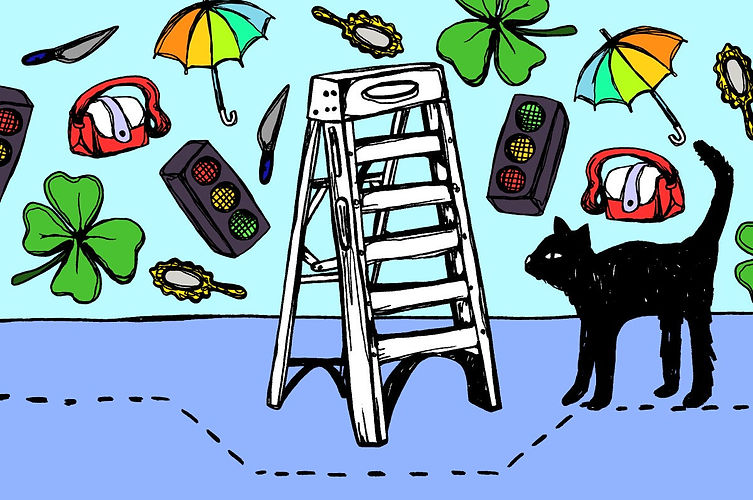
In some cultures, everyday objects can become symbols of bad luck. In Portugal, for example, many believe that walking backwards brings bad luck, so people avoid doing it on purpose. In the United States and several European countries, people try not to walk under ladders or to break mirrors, because these actions are thought to bring misfortune. In contrast, in Ireland and other parts of Europe, finding a four-leaf clover or a horseshoe is believed to bring good luck.
Although superstitions differ, they also show some common patterns across cultures. Many superstitions focus on protection from danger, such as the “evil eye” in Mediterranean and Middle Eastern countries, where people wear special blue or black amulets to protect themselves from jealousy or bad wishes. Others focus on success and prosperity, like lucky numbers, New Year foods, or special gestures before exams or sports competitions. In this way, superstitions both separate cultures and connect them, because people everywhere hope for safety, health, and good luck.
Comprehension focus: compare and contrast
Students can notice:
-
Similarities
-
Many cultures have “unlucky numbers” (13 in Western countries vs. 4 in China).
-
-
Many New Year traditions are meant to bring luck (grapes in Spain vs. open windows in the Philippines).
-
Differences
-
Some actions are unlucky in one place but unknown in another (walking backwards in Portugal vs. walking under ladders in the U.S.).
-
-
Protection symbols vary (evil eye amulets vs. four-leaf clovers and horseshoes).
Possible B2 language targets:
-
Comparing: “similar to,” “in contrast,” “unlike,” “while,” “both…and.”
-
Hedging: “seem to,” “are often believed to,” “many people think that…”.

Quiz 1
Directions
Read the article “Superstitions Around the World.” Then choose the best answer (A, B, C, or D) for each question. Circle the letter of the correct answer.
-
What is the main idea of the article?
A. Superstitions are disappearing in modern societies.
B. Superstitions are the same in every culture.
C. Superstitions show both similarities and differences across cultures.
D. Superstitions are more important than religion. -
Why do many buildings in Western countries avoid the number 13?
A. Because it sounds like the word for “death.”
B. Because it is difficult to pronounce.
C. Because people think it is unlucky.
D. Because it is too close to the number 12. -
In China and other East Asian countries, which number do people often avoid, and why?
A. 3, because it is a very small number.
B. 4, because it sounds like “death.”
C. 7, because it is connected to ghosts.
D. 8, because it is considered unlucky. -
What is one thing that New Year superstitions in Spain and the Philippines have in common?
A. Both involve avoiding certain numbers.
B. Both are connected to eating grapes.
C. Both are meant to bring good luck for the future.
D. Both tell people not to open their windows. -
According to the article, what do many people in Portugal believe?
A. Walking backwards brings bad luck.
B. Ladders should always be left outside.
C. Mirrors can show the future.
D. Black cats are lucky animals. -
Which superstition is common in the United States and several European countries?
A. Eating 12 grapes at midnight on New Year’s Eve.
B. Avoiding the number 4 in phone numbers and addresses.
C. Not walking under ladders because it brings bad luck.
D. Wearing blue and white amulets to protect against jealousy. -
What is the purpose of “evil eye” amulets in some Mediterranean and Middle Eastern cultures?
A. To bring rain and good weather.
B. To protect people from jealousy or bad wishes.
C. To help students pass their exams.
D. To make mirrors less dangerous. -
Which sentence best describes a similarity between cultures mentioned in the article?
A. Only European countries believe in lucky numbers.
B. All countries use the same color for protective amulets.
C. Many cultures have special actions or objects to attract good luck.
D. Most cultures completely reject superstitions today. -
Which sentence best describes a difference between cultures mentioned in the article?
A. Every culture believes that breaking a mirror is unlucky.
B. Western countries avoid 13, while some East Asian cultures avoid 4.
C. All countries eat special food on New Year’s Eve.
D. Only Asian countries use symbols for protection. -
What does the article suggest about why superstitions are important to people?
A. They always give a scientific explanation for events.
B. They help people feel some control in an uncertain world.
C. They make travel more difficult between countries.
D. They are more powerful than laws and rules.
-
Answer key
-
C
-
C
-
B
-
C
-
A
-
C
-
B
-
C
-
B
-
B
Other ESL Reading Tasks from Academic Tutors USA
--- --- ---
CLICK HERE
--- --- ---
CLICK HERE
--- --- ---
CLICK HERE
--- --- ---
CLICK HERE

"There are more things in heaven and earth, Horatio, than are dreamt of in your philosophy,"
Act 1, Scene 5 - Hamlet to Horatio